A Journey into Stillness at Park Hyatt Kyoto
9 Jan. 2026
9 Jan. 2026
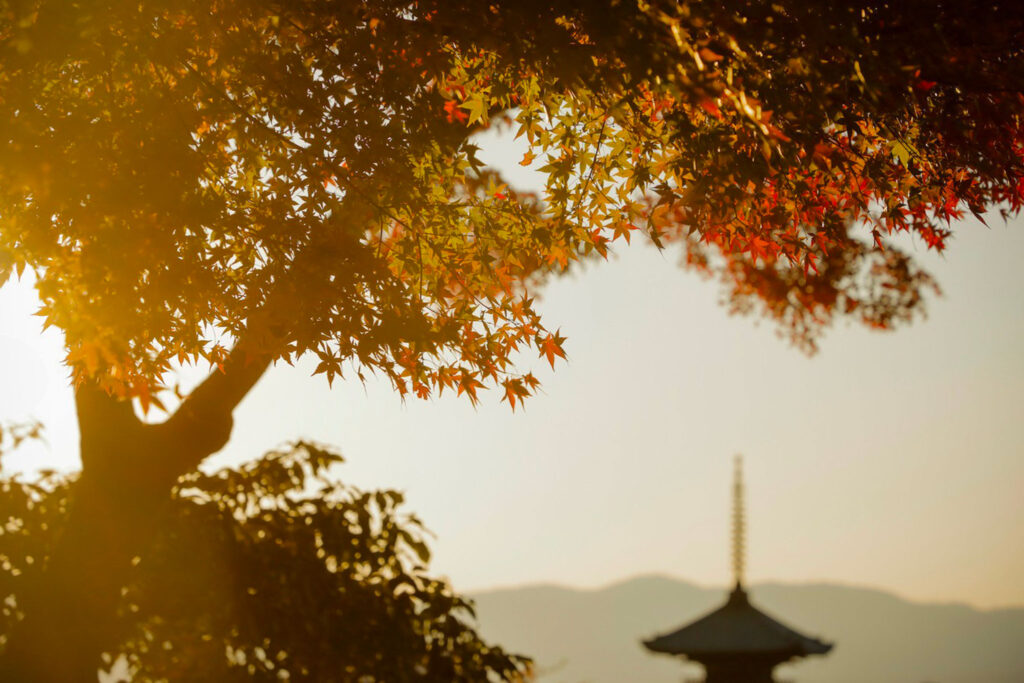
There is a moment, halfway up the hillside of Higashiyama, when Kyoto suddenly feels eternal. The tiled roofs ripple like waves, Yasaka Pagoda rises like a quiet sentinel, and the hum of pilgrims on Ninenzaka softens into a faint rhythm carried by the wind. Then, at the curve of the slope, almost hidden, almost whispered, a discreet entrance opens onto another world entirely.
Step inside, and the city exhales. The air cools. Light shifts. And the old capital reveals not its bustle, but its stillness.
This is Park Hyatt Kyoto, not merely a hotel but a luxury guesthouse conceived as a poetic continuation of one thousand years of Higashiyama’s cultural memory. Here, tradition is not performed, it is lived. Serenity is not décor, it is architecture. Every path, every window, every quiet pause invites guests deeper into Kyoto’s unbroken flow of time.
For generations upon generations, noble families and the ruling elite built their retreat homes on these forested slopes. They came for the same things travelers still seek today: closeness to nature, silence, refinement, and the craftsmanship that has defined Kyoto for centuries, from ceramics and tea ceremony to kimono dyeing, sake brewing, calligraphy and ink wash painting.
Higashiyama may appear bustling on the surface, but behind each slatted façade lie layers of artistry shaped slowly, lovingly, across hundreds of years.
Park Hyatt Kyoto is born from this heritage. Its foundations are not just stone and timber, but stories, rituals, families, gardens, and memories, preserved and reimagined for a new era.
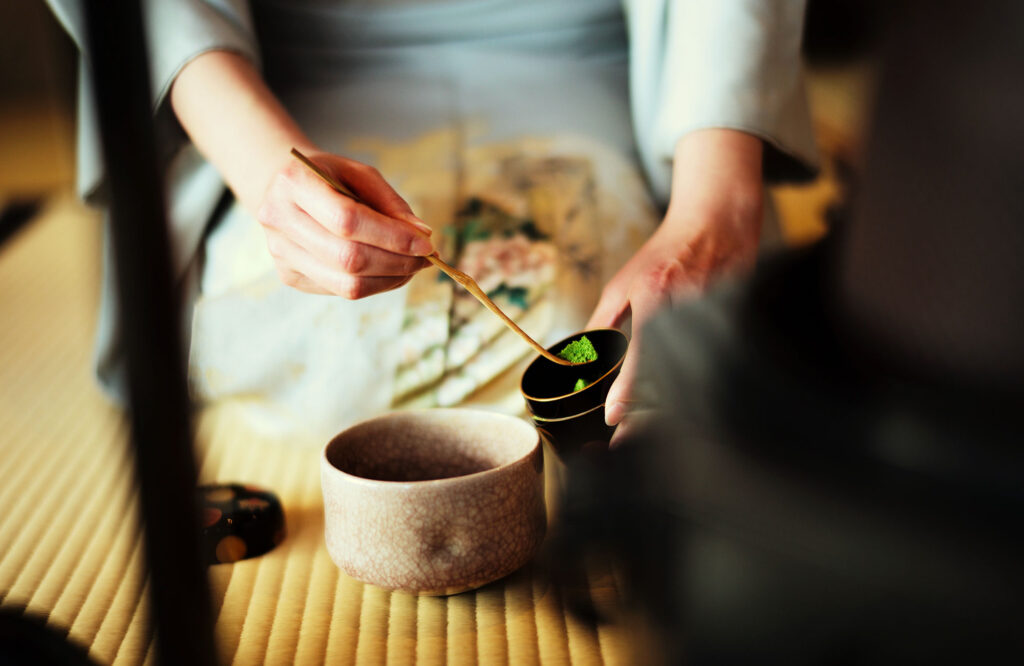
Beneath the hotel’s soft lines of cypress and ash sits a soul even older: Kyoyamato, a seventh generation ryotei whose history is woven into Kyoto’s political, artistic, and spiritual fabric.
The land once belonged to a lineage of Buddhist temples and eventually became part of Nishi Honganji. In the nineteenth century, within its austere wooden halls, samurai revolutionaries debated the future of Japan. After the upheaval, Kyoyamato transformed the former temple into a teahouse and dining retreat, one where geisha danced for Japan’s leaders, where statesmen passed through discreetly, and where hospitality itself became an expression of art.
Today, Kyoyamato remains a sanctuary of kaiseki mastery. Its historic teahouse Soyo tei, nearly four hundred years old, still opens its screens to private dinners, its tatami rooms scented with cedar and incense, its gardens shaped like living poetry. The dishes change with the season, the calligraphy scrolls change with the mood, the flowers change with the day.
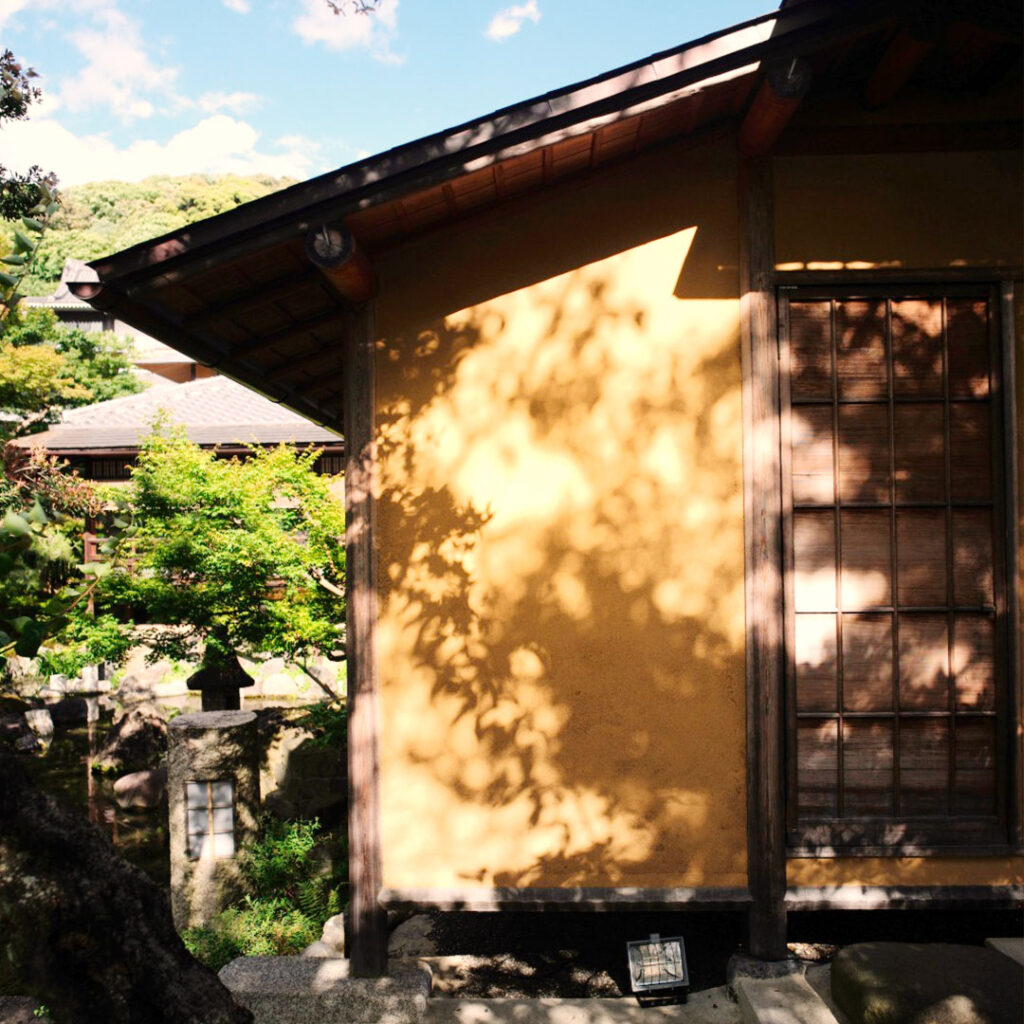
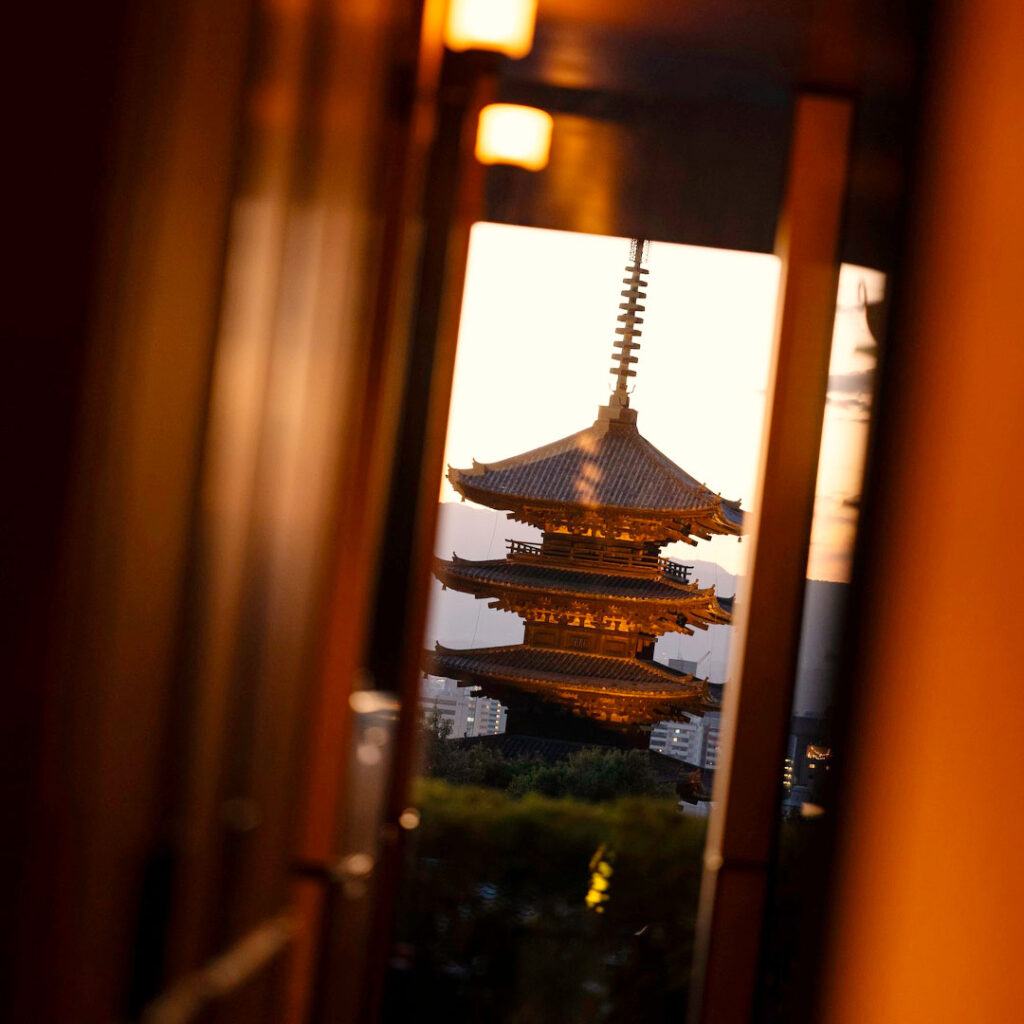
When Kyoyamato, Takenaka Corporation and Hyatt joined hands to create Park Hyatt Kyoto, the ambition was not to build above history, but to build within it.
Takenaka, whose craft lineage in temples and shrines stretches over four centuries, approached the project with reverence. The result is a structure that seems to have risen organically from the hillside, a constellation of low, tiled roofs blending seamlessly with the townscape, layered façades softening the boundary between inside and outside, and passageways that feel like they were always meant to exist.
The guiding philosophy is teioku ichinyo, the oneness of garden and house, a belief that architecture should dissolve into nature rather than dominate it.
At Park Hyatt Kyoto, the rooflines echo the waves of surrounding machiya rooftops, every sightline is orchestrated to frame Yasaka Pagoda from unexpected angles, gardens flow into corridors, corridors slip into courtyards, and courtyards return to views of the city. Kyoto Bistro opens directly onto the lively hum of Ninenzaka, bridging street life and serenity.
It is not a building, it is a dialogue with mountains, with history, with light.
The entire property unfolds as a double looped strolling garden, a modern interpretation of the kaiyushiki en, Japan’s traditional circuit garden designed for meandering, reflection, and discovery.
Landscape architect Yasuo Kitayama, known for shaping some of Kyoto’s most revered temple gardens, brought his Zen philosophy to the property. His gardens are intentionally “unfinished,” meant to evolve day by day, season by season, offering guests a new emotion with each step.
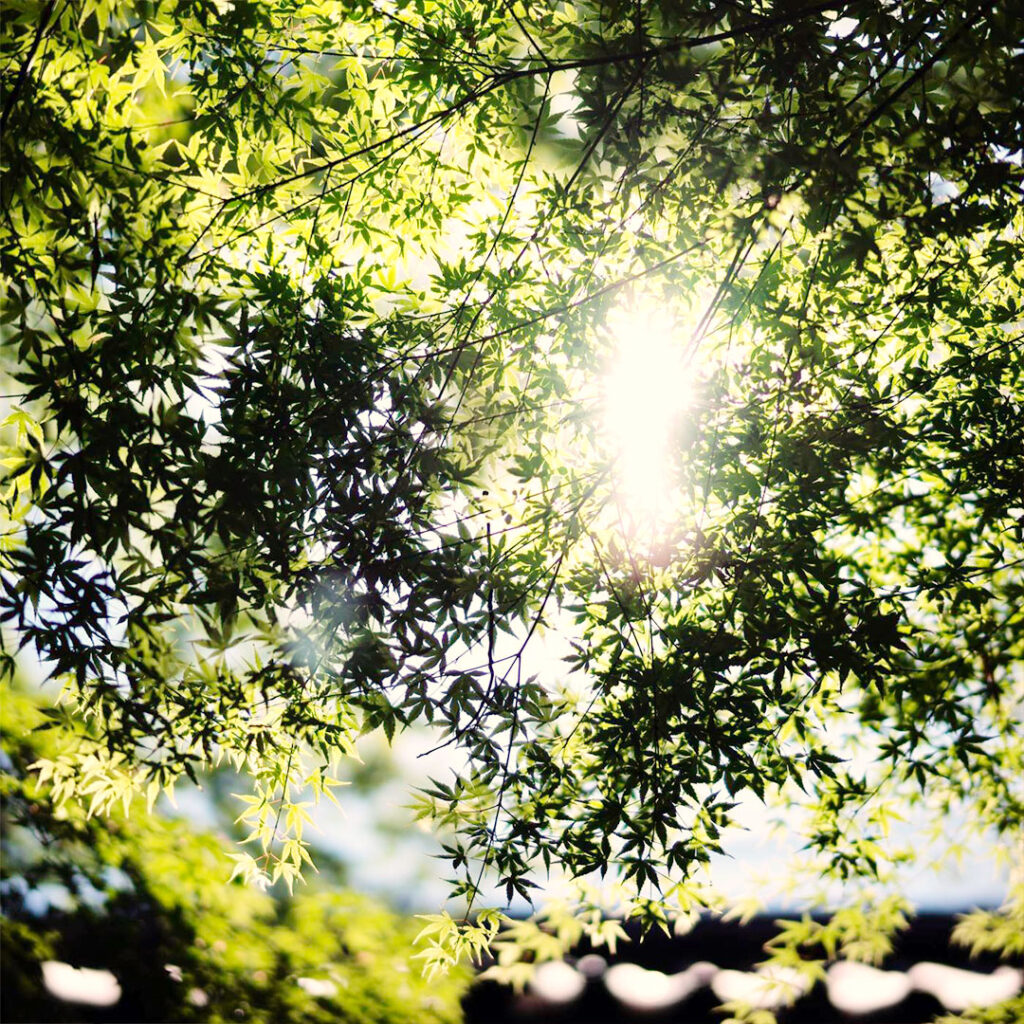
Water murmurs through hidden channels, stone lanterns guide evening paths, maple leaves ignite into amber in autumn, while camellias glow in the winter sun. Rare plants and animals thrive here, including the forest green tree frogs carefully preserved and returned to the garden after construction.
The Pritzker Garden holds ancient stones from Colorado, three hundred million years old, selected by Kitayama himself and gifted by Hyatt’s Executive Chairman, Thomas Pritzker. They stand like honored guests from another era, greeting all who arrive.
At Park Hyatt Kyoto, nature becomes time, and time becomes a companion.
Japanese architectural philosophy speaks of oku to tsugi, depth and next, a choreography of spaces designed to draw guests gradually into intimacy.
Park Hyatt Kyoto embodies this beautifully.
Guests begin their journey through a dramatic entrance evoking waterside scenery with a dry waterfall, passing through a gate reminiscent of a samurai residence. From there, the world unfolds in quiet layers. Moving through a cloistered walkway flanked by stones from the Horyu-ji temple precinct and others spanning more than 300 million years, guests arrive at a high-ceilinged reception hall etched with shadow, which leads into a lobby filled with warm, softly glowing golden light. Ascending to the fifth floor, a garden-facing lounge, an open-air corridor scented by the seasons, and a carefully curated library appear along the way—each space a pause and a deepening.
By the time guests reach the guest rooms, set purposefully far from the entry, the transition from public to private feels instinctive, like slipping into another state of being.
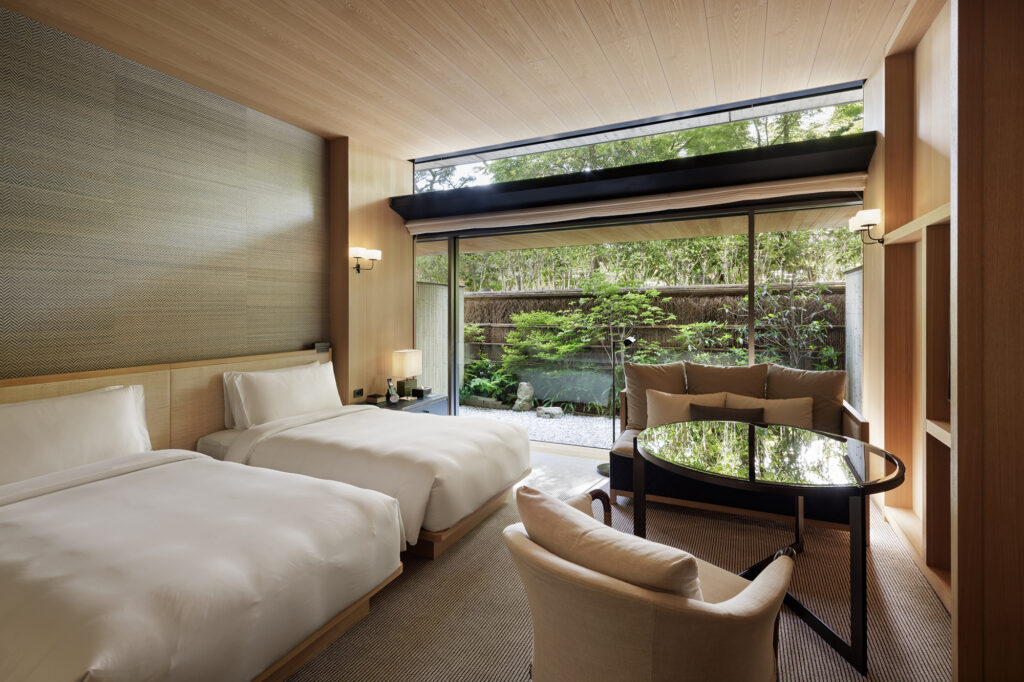
Rooms at Park Hyatt Kyoto are crafted as tranquil cocoons, with tamo wood, Japanese cypress, soft textiles, original artwork, and views that shift gently with the seasons.
Among them, three suites stand like poems.
Ninenzaka House, with its sixty-eight square metres, is a hillside residence facing the renowned Ninenzaka slope that leads to the World Heritage site of Kiyomizu-dera, opening onto Yasaka Pagoda and the city’s traditional townscape. Crafted to feel both timeless and modern, the interior captures the intimate, quiet drama of dusk as it settles over Kyoto.
Higashiyama House, at ninety square metres, is generous, residential, and serene. With its separate living room and bedroom and its expansive city views, it feels like a private apartment in the heart of Kyoto’s most storied district.
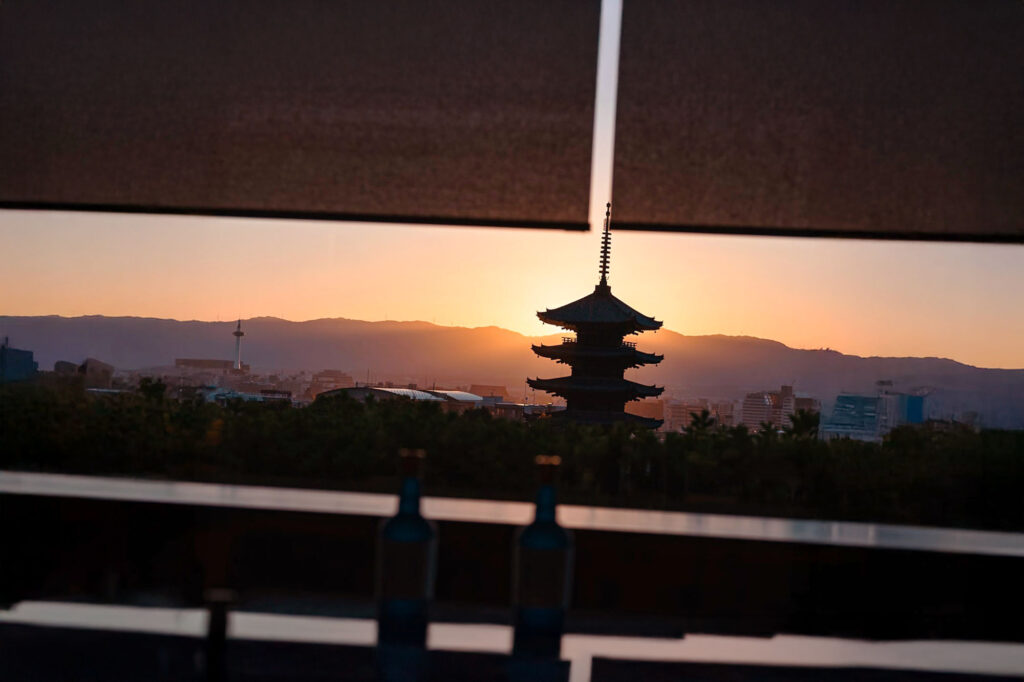
Pagoda House, at one hundred and thirty-five square metres, is the crown jewel, perched at the pinnacle of the hotel. Here, the trees planted in the garden of Kyo-Yamato preserve a sense of privacy, while Kyoto’s icon—the pagoda—and the cityscape beyond spread above the foliage like living art, shifting from a silhouette at dawn to a gold-lit dusk. Inside, the interiors cocoon guests in subtle textures and soft light.
Each room is a contemplation, an exhale, a return.
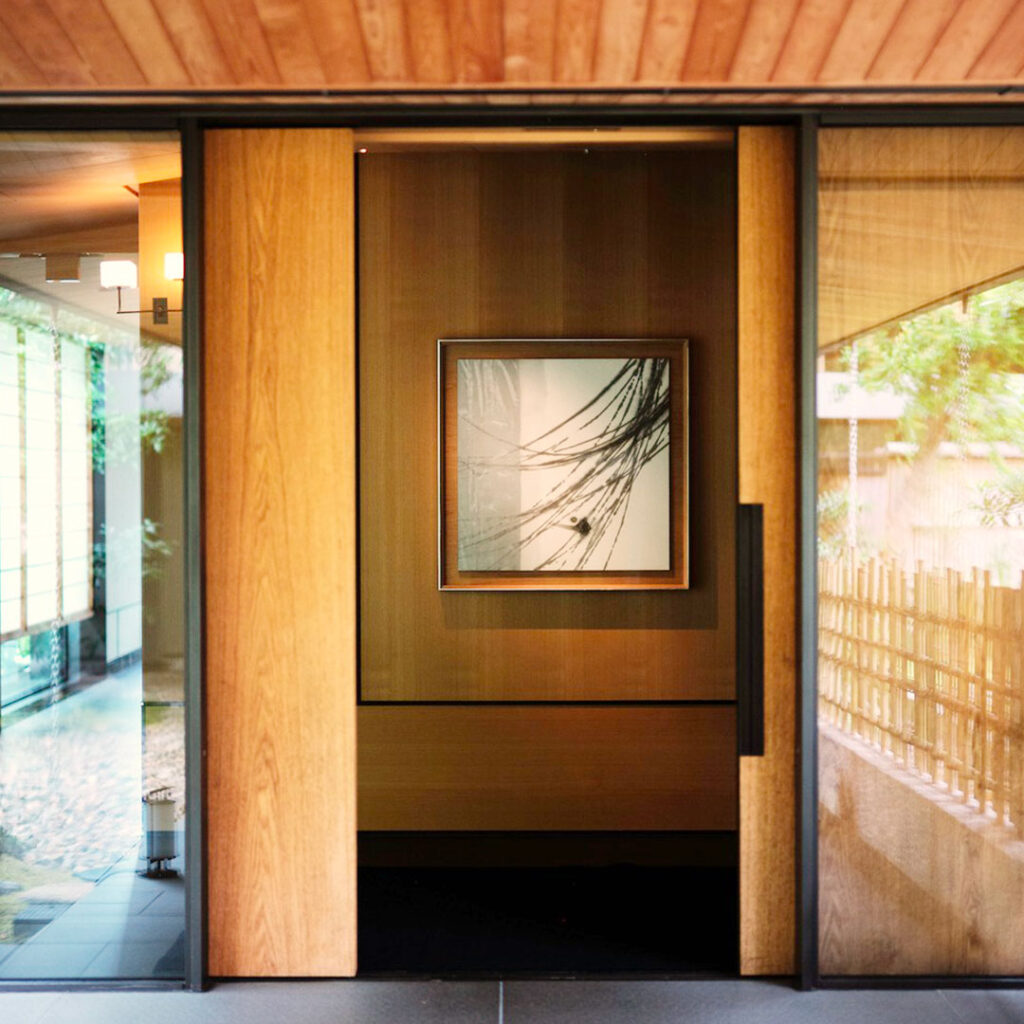
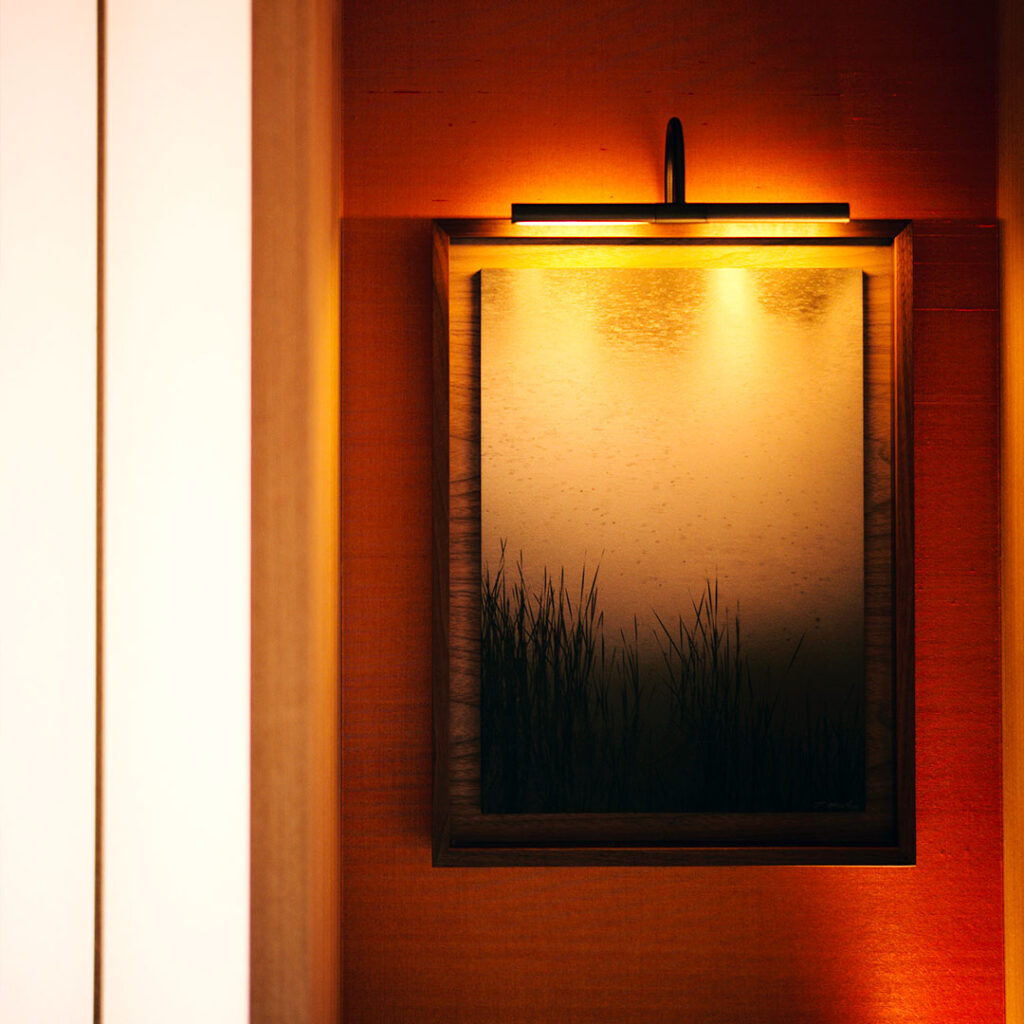
Takenaka’s master carpenters revived traditional methods. Wood beams are fitted without nails, gently curving mukuri roofs evoke the elegance of courtly residences, and textured walls recall the historic Jurakudai palace of Toyotomi Hideyoshi. Kinpaku gold leaf accents catch the faintest glimmers of light without ever intruding on the quiet.
Interior designer Tony Chi layered these traditions into warm, tactile interiors that feel at once ancestral and contemporary. Even the fitness center echoes the quiet discipline of a dojo, a place of focus rather than spectacle.
Art throughout the hotel echoes Kyoto’s deep spiritual roots. Sumi ink paintings, wood and stone carvings, indigo textiles, bronze and glass sculptures all appear as if they were offerings placed with care. The works, including pieces by artists such as Katsutomi Horiki, Fabrizio Corneli and Toko Shinoda, embrace the wabi sabi beauty of impermanence and deepen the sense that this is a place where art and prayer share the same language.
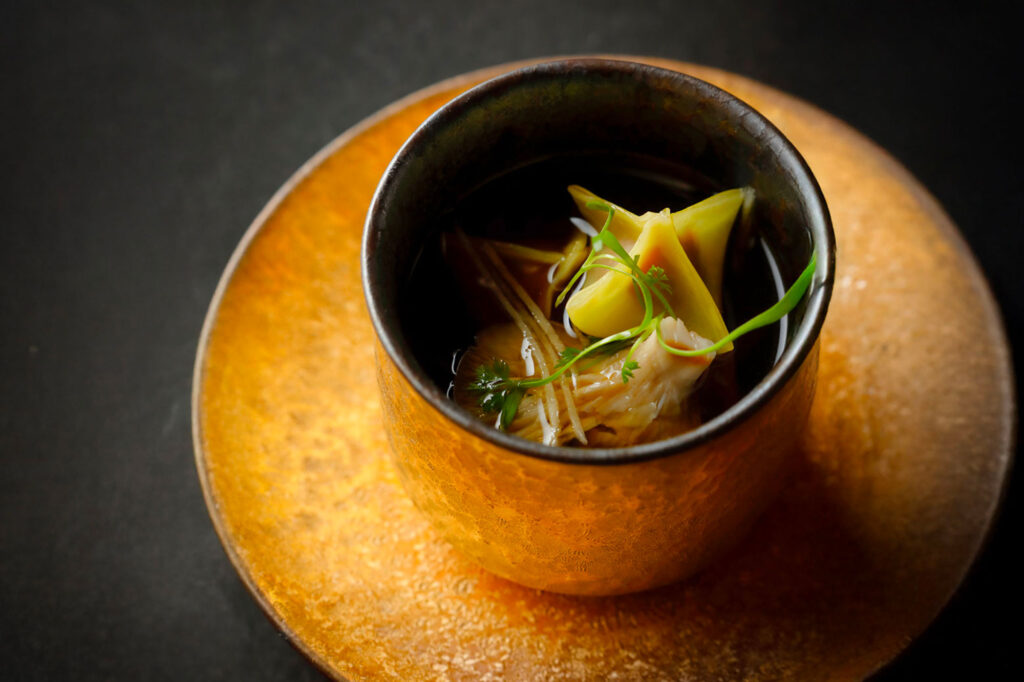
Dining at Park Hyatt Kyoto is a journey through flavor, memory, and seasonality.
At Kyoto Bistro, street life and culinary craft meet in dishes prepared with local, seasonal ingredients and served on handmade Asahiyaki earthenware. Guests can linger over pastries and cakes, craft coffee or tea, while watching the gentle theatre of Ninenzaka outside.
In The Living Room, a five-course Afternoon Tea unfolds beside a softly glowing hearth. Carefully paired Japanese teas and delicate sweets, bathed in golden light and accompanied by the gentle resonance of the koto, create a ritual that feels both domestic and ceremonial.
At Yasaka, French inspired teppanyaki is performed on the traditional steel teppan, while the city glitters beyond the glass. The experience is part theatre, part fine dining, with each course shaped by both Kyoto terroir and French technique.
Kohaku, the hotel’s intimate bar, offers rare Kyoto made whiskies, sake, and gin, framed by floor to ceiling views of Yasaka Pagoda. Dark woods, leather textures, and the shifting patterns of night over the city set the tone for slow, reflective evenings.
In winter, the culinary narrative becomes even richer. Festive menus span Yasaka, The Living Room and Kohaku. Kyoto Bistro welcomes Chef Stephan Pantel for a special collaboration, while Michito Kaneko of Lamp Bar, one of Asia’s 50 Best Bars, appears at Kohaku for an exclusive mixology experience.
For guests who wish to immerse themselves fully, the “Savor & Stay: Yasaka Dinner with Welcome Champagne” package offers a curated way to experience the hotel’s gastronomic heart, pairing a dinner at Yasaka with a glass of champagne on arrival, during a stay bookable within the winter season.
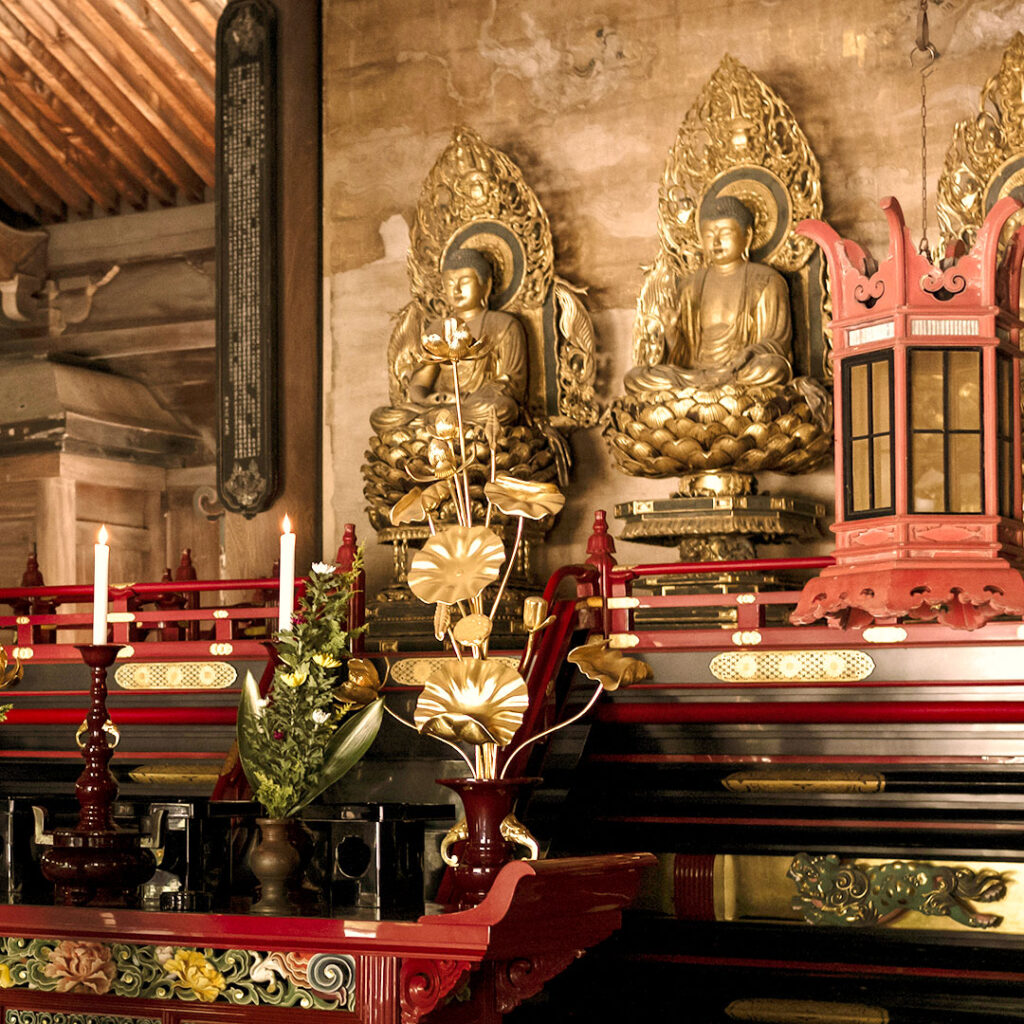
For those seeking spiritual stillness, Park Hyatt Kyoto opens the gates to Sennyu ji Temple, long associated with the Imperial Family. In its hallowed halls, guests can practice Ajikan, a form of Shingon Buddhist meditation rooted in breathing, visualization, and awareness.
The experience is gentle yet profound, a rare chance to encounter Kyoto’s spiritual heritage not as a spectator, but as a participant.
Although Kyoto is defined by its temples, teahouses, and preserved machiya, it has always embraced innovation. This is the city of Nintendo, of pioneering universities, of global companies born from craftsmanship and curiosity. Park Hyatt Kyoto, Kyoyamato, and Takenaka stand precisely at this intersection, honoring the past, elevating the present, and shaping the future.
And so the journey ends as it began. On the slope of Higashiyama, where the roofs shimmer like a sea and Yasaka Pagoda rises in quiet dignity. Where a door opens onto serenity. Where guests discover not just a hotel, but a place where the pulse of Kyoto beats softly, steadily, eternally.
A sanctuary above the city.
A guesthouse shaped by memory.
A story that continues, one quiet step at a time.
Booking Park Hyatt Kyoto with Lartisien means more than securing a room. It offers a thoughtfully curated approach to the stay, with access to preferred room categories, added touches, and guidance shaped around the way you travel. Every detail is considered, ensuring an experience that feels seamless, refined, and true to the spirit of Kyoto.
Because where you stay matters—but how you experience it matters more.