

"Images chantées"
In Louis Aragon’s hands, words become song, bringing the vivid, surreal world of Greek painter Alekos Fassianos to life. Like an aria or a serenade, where love is given voice through melody and gesture, Fassianos’s lines gather into waves, into incantations. This is the artist as the poet saw him.
Below, photograph of Aragon's apartment at 56 rue de Varenne, Paris © Claude Bricage Collection Maison Elsa Triolet-Aragon

In Homer’s Odyssey, the archetype of the great journey, even the grandest feats of war and conquest are ultimately at the mercy of love. It is this unruly force, by turns incandescent and impossible to contain, that courses through Alekos Fassianos’s paintings, animating gods and heroes as readily as the more familiar figures of everyday life. His world draws on the splendour of an imagined antiquity: windblown hair, jaunty hats, bodies caught in motion, set against still lifes whose rounded forms possess something of Botero’s guileless charm. Everywhere, the same dream of the Mediterranean, less a place than a state of mind. It emerges first in the colours: vermilion burning against azure, lapis lazuli following the contours of a boldly drawn figure.
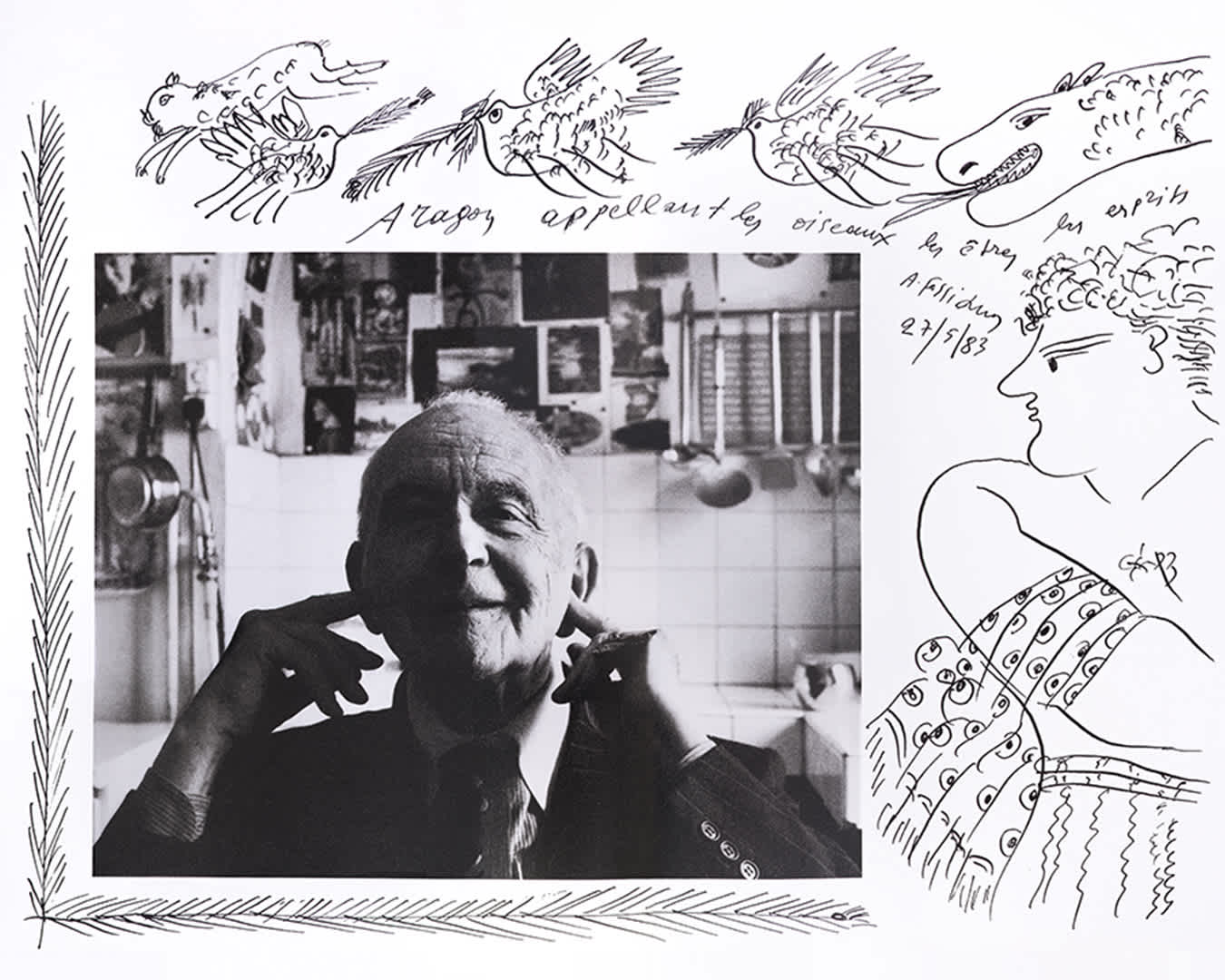
Few understood this dialogue between past and future as instinctively as Louis Aragon, who wrote of Fassianos: “O you, repeat the name of this painter whom I so love to ‘read’ today, deep in the eyes of my mind and upon the walls of a new dream, somewhere between Matisse and Miró…” To look at Fassianos is to enter a story without a beginning or an end, where images are read as one might read a novel. Odysseus and Calypso are bound by an impossible love; Circe casts her spell; Penelope waits, suspended in the long ache of longing.
Alekos Fassianos, drawing over an Aragon portrait for Aragon parmi nous by Monique Dupont-Sagorin, éditions du Cercle d’Art, 1997
The ardour that coursed through the love affair — both amorous and literary — between Louis Aragon and Elsa Triolet, a life’s work shared between two souls, finds another expression in the poet’s gaze upon the art of his visual companion, Alekos Fassianos. The exhibition moves from the first room, where Aragon’s words seem to have gathered Fassianos’s universe into a kind of living archive, among works that bear the imprint of their years of friendship, towards a more polyphonic encounter, in which the works themselves become interlocutors, each fluent in two artistic tongues.
Here, the written word answers the painted line; verse takes up the colour, and poetry enters into the realm of the pictorial. The two move in concert, at once distinct and inseparable, each drawing the other into its orbit. And from this reciprocal enchantment emerges a quiet revelation: love, in its broadest and most elusive sense, may also be written — or painted — into being, through the works that speak in our stead.
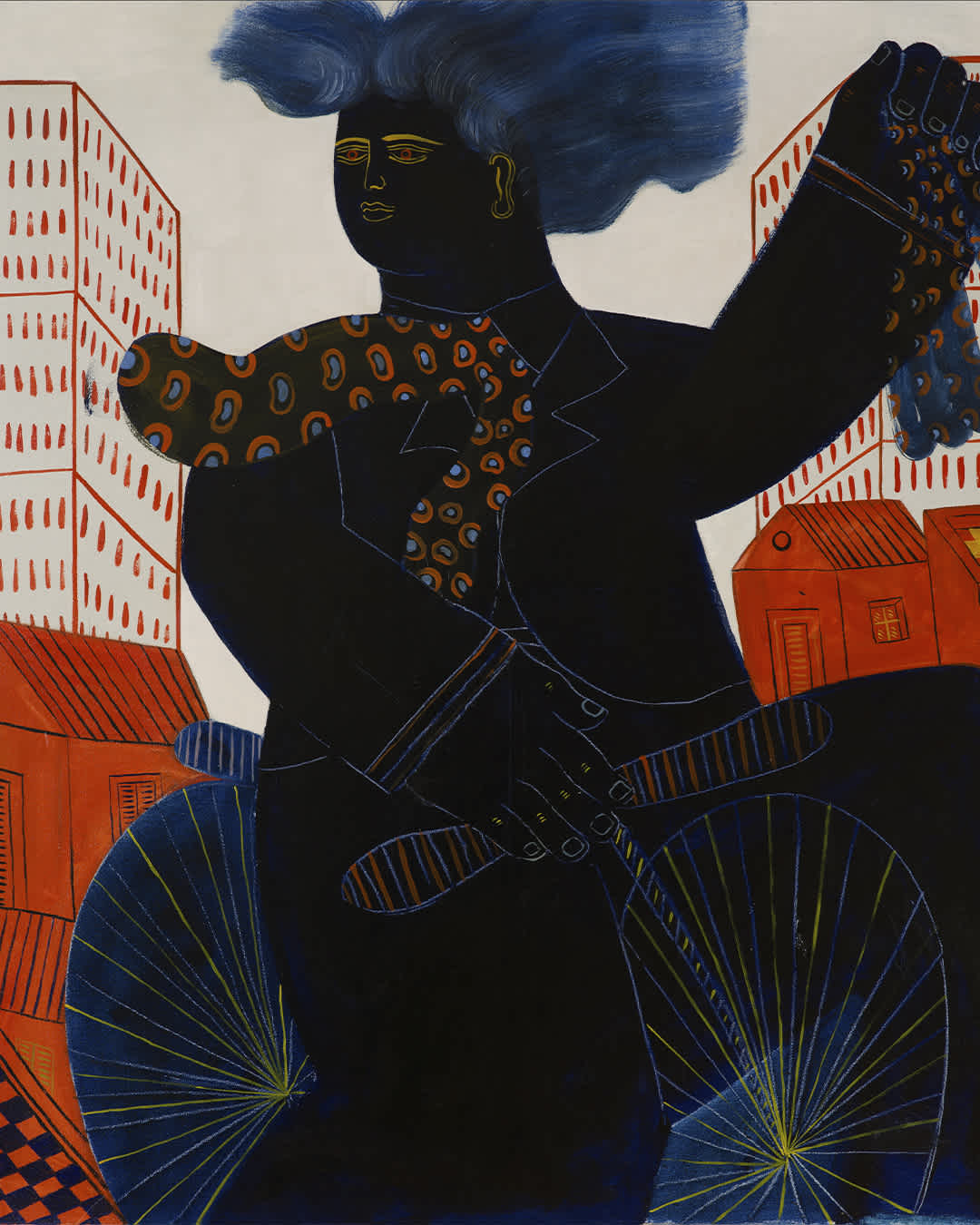
Alekos Fassianos, Cycliste, oil on canvas,1977
Images Chantées, 22 October – 12 December 2026, 13 rue d’Aguesseau, Paris 8th arrondissement.
An exhibition presented by Éditions Syrmos, the Maison Elsa Triolet-Aragon and the Alekos Fassianos Museum.
Curated by Marion Gardair.